

-
Certificates


Find certification bodies for your selected ISO standard
-
Most Popular ISO Certifications ★
-
Management and Quality
-
Environment and Sustainability
-
Occupational Health, Safety and Wellbeing
-
Information Security and IT
-
Compliance and Business Continuity
-
Artificial Intelligence and Innovation
-
Food Safety and Agriculture
-
Transport, Logistics and Rail
-
Automotive, Aerospace and Defence
-
Medical Devices and Healthcare
-
Construction and Industry
-
Cosmetics and GMP
-
Energy and Fuels
-
Professional Services
-
- How It Works
- Certification Guide
- PL
- EN

-
Certificates
Find certification bodies for your selected ISO standard
-
Most Popular ISO Certifications ★
-
Management and Quality
-
Environment and Sustainability
-
Occupational Health, Safety and Wellbeing
-
Information Security and IT
-
Compliance and Business Continuity
-
Artificial Intelligence and Innovation
-
Food Safety and Agriculture
-
Transport, Logistics and Rail
-
Automotive, Aerospace and Defence
-
Medical Devices and Healthcare
-
Construction and Industry
-
Cosmetics and GMP
-
Energy and Fuels
-
Professional Services
-
- How It Works
- Certification Guide
-
EN
ISO Certification Maintenance 01 Feb 2026
First ISO Recertification – The Moment When Companies Overpay the Most
The first ISO recertification is the point at which many companies automatically accept higher certification costs. Meanwhile, a recertification audit is shorter than initial certification, and the market offers real, competitive alternatives.

Many organizations treat the first ISO recertification as a natural continuation of cooperation with their existing certification body.
The ISO certificate is already in place, the management system is functioning, and surveillance audits have been completed without major issues - so entering another three-year cycle often feels like a mere formality.
In practice, the market tells a very different story.
The first recertification is precisely the moment when companies most often accept increased certification costs without comparing alternatives and without conducting a real market analysis. Not because they have no choice, but because the decision is made out of routine.
This is not accidental.
It is a market mechanism.
Why is the first recertification a critical cost point?
The first recertification marks the beginning of a new three-year certification cycle. For the certification body, this is the moment to replan audits, recalculate audit time, assign audit teams, and update commercial conditions.
This is also where significant price adjustments often appear.
It should be noted, however, that cost increases at the first recertification are not always unjustified. Between initial certification and the first recertification, a three-year period typically passes during which the operating costs of certification bodies change - including auditor labor costs, inflation, travel expenses, as well as organizational and accreditation requirements.
Organizations that obtained attractive conditions in the first cycle (often at an “entry-level” price) tend to assume these conditions will be maintained. In reality, after three years, the situation changes. The certification body already has the client “on file,” and changing providers may seem organizationally inconvenient.
The result?
The first recertification is the moment when the cost of maintaining an ISO certificate most often undergoes a significant adjustment.
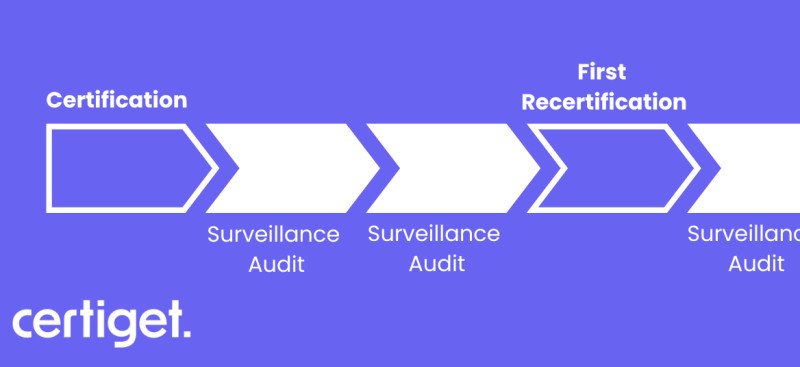
First recertification means a shorter audit – a 1:1 comparison with initial certification is a mistake
One of the most frequently overlooked facts in cost discussions is the actual scope of the audit.
A recertification audit is not the same size as an initial certification audit. The organization already holds a valid certificate and has documented evidence of ongoing compliance.
According to standard audit planning practices, the first recertification audit is usually shorter than the initial certification audit.
Therefore, comparing costs “one-to-one” with initial certification is a misinterpretation.
If audit time is reduced while costs increase, the organization has every reason to ask for a clear justification of the price increase.
Market observations: the largest differences appear after the first cycle
Analyses conducted by Certiget, based on comparisons of ISO certification offers, clearly show that the greatest asymmetry between certification body offers appears after the first certification cycle - not at the initial certification stage.
In practice, many organizations are unaware that:
- audit time can be planned differently,
- cost calculation mechanisms vary between certification bodies,
- the first recertification is a natural moment to renegotiate terms,
- certificate transfer is a real market option - not a “last resort”.
The ISO certification market is not uniform. Certificates may look similar, but cooperation terms and costs in subsequent cycles can differ significantly.
Certificate transfer is not limited to recertification
A common misconception is that changing the certification body is only possible at the time of recertification.
In reality, certificate transfer can be carried out in any year of the certification cycle, including between surveillance audits.
A reliable certification body should offer flexibility of cooperation, without:
- contractual penalties,
- long notice periods,
- artificial long-term lock-in.
ISO certification is a long-term relationship, but it should never be a closed one.
The first recertification is the best moment to compare certification bodies
Just before the first recertification, it is worth asking:
- Are the audit conditions still adequate to the scale of operations?
- Do the costs reflect the actual audit workload?
- Does the certification body add value, or merely perform a formality?
- Are there better-matched options available on the market?
Certiget was created to help organizations make such decisions consciously - based on data, offer comparisons, and verified experiences of other companies after audits.
On certiget.pl and certiget.eu, you can find a detailed catalog of management system certification bodies from around the world, with the ability to compare offers and search by standard.
Summary
The first ISO recertification is the moment when companies most often overpay, because decisions are made routinely, without comparing alternatives.
A recertification audit is, by definition, shorter than initial certification, yet its cost is often comparable. Certificate transfer is possible in any year of the cycle and serves as a real market-balancing mechanism.
The first recertification is not just an audit.
It is a strategic cost decision for the next three years.
Article author
-avatar.webp)
Laura K. Mokrzycka
Certification Body Profile Manager
Certiget
Laura as the Certification Body Profile Manager, is responsible for creating, updating, and developing the profiles of certification bodies listed in the Certiget directory. She ensures the consistency of information, verifies accreditation details and service scope, and supports certification bodies in presenting their offers in a way that is both attractive and aligned with client expectations.
Share this article


